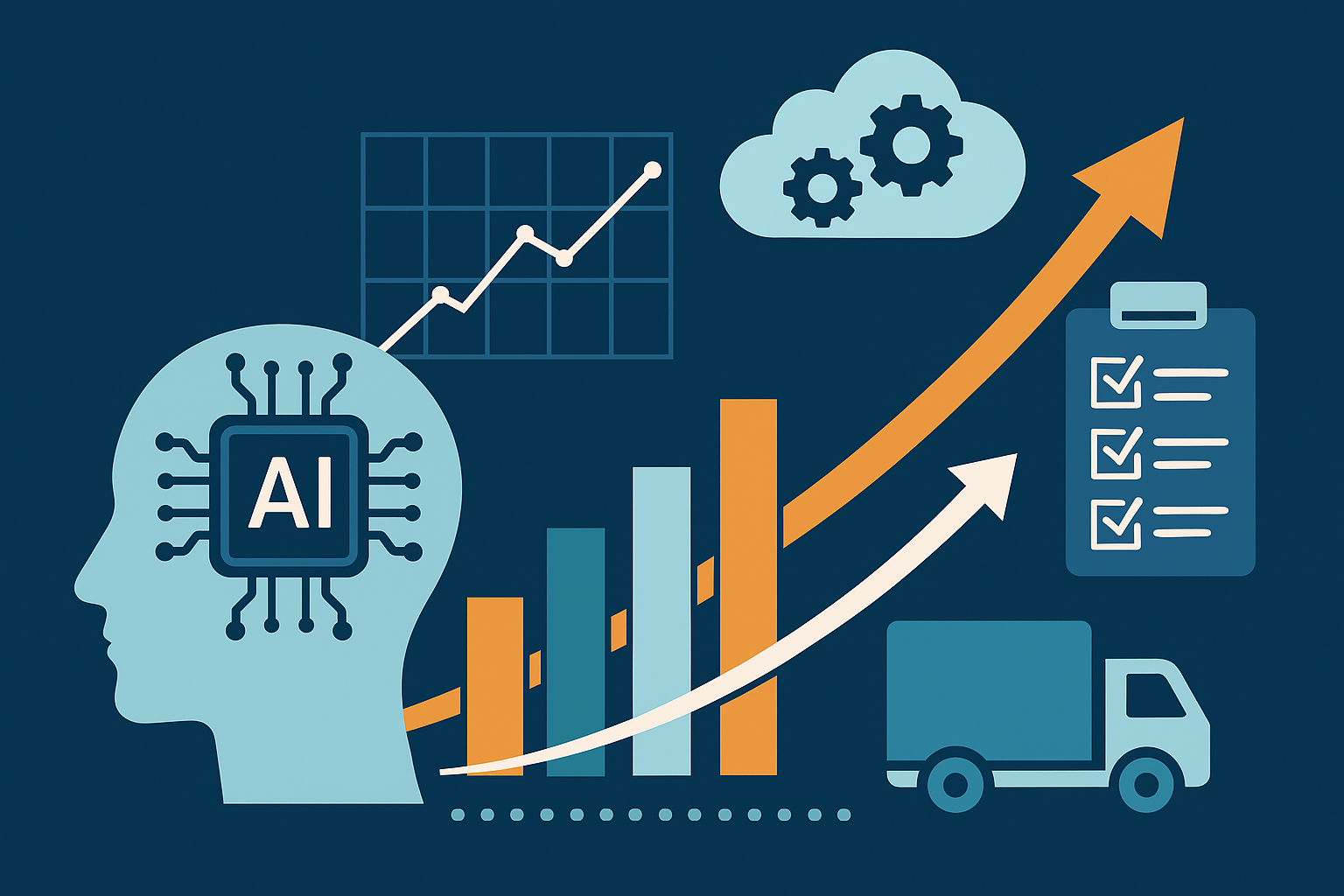
The application of artificial intelligence to demand planning processes and S&OP decision-making is transforming how industrial companies assess the future and define their strategies. The focus is no longer solely on improving forecast accuracy, but on making the entire S&OP cycle more responsive, predictive, and oriented toward operational impact.
AI makes it possible to connect demand, production capacity, constraints, materials, and financial objectives within a single model, capable of dynamically representing the supply chain and generating alternative scenarios. The critical step is understanding how AI can turn forecasting into an active element of the process, enabling immediate impact assessment and supporting more informed decision-making.
Prerequisites: how to prepare data and processes for the use of AI
The foundation of the process
AI can create value only if the data used accurately reflects operational reality. Preparing data means building a coherent, integrated, and up-to-date information environment, where demand, production capacity, material availability, and service levels are described with the level of granularity required to support advanced models.
At this stage, it is essential to work on three key dimensions:
- The quality and consistency of demand history, removing distortions caused by exceptional events, stock-outs, or inconsistent coding.
- The structure and completeness of master data – products, customers, resources, and bills of materials – so that models can recognize patterns and relationships across the entire value chain.
- The availability of reliable operational data, such as actual lead times, real capacity, production calendars, service parameters, and sourcing rules.
Data collection from the field
To generate credible simulations, the model representing capacity and material availability must reflect the actual behavior of production systems. A continuous real-time data flow is not required for the S&OP cycle; what is needed are solid, up-to-date parameters derived from production systems.
MES systems, IIoT solutions, and shop-floor platforms provide the data needed to accurately estimate:
- actual cycle times and variability
- line efficiency and typical utilization levels
- real availability of critical resources
- scrap rates, yields, and process quality
- nominal capacity versus truly usable capacity
These data do not feed the demand forecasting process directly, but they are essential for building a supply constraint model that allows AI to assess the feasibility of decisions.
Why is this essential?
A dataset prepared for AI is not just clean; it is integrated and contextualized. This allows the model to analyze how a change in demand affects:
- the use of critical materials
- resource utilization and saturation
- margins and operating costs
- the ability to meet service level targets
The ability to correctly interpret operational constraints within the data enables the next step: the simulation of realistic scenarios that support strategic and tactical decisions and allow the analysis of truly feasible alternatives.
How AI improves forecasting and prepares the ground for simulation
The role of machine learning
The integration of AI into the demand planning process begins with machine learning models capable of analyzing demand history, identifying recurring patterns, and correlating variables influenced by market dynamics.
AI makes it possible to account for factors that are difficult to manage with traditional statistical models, such as irregular trends, promotional effects, local variations, or mix volatility.
AI does not replace existing forecasting; it extends it. Models are trained, validated, and then integrated into the planning process, updating forecasts with greater frequency and responsiveness. Forecasts become more stable and more finely segmented by product family, customer, market, or service level, making it easier to link demand with production capacity.
Why does it matter for simulation?
The value goes beyond accuracy. An AI-generated forecast is already designed to interact with materials, capacity, and costs. It becomes the starting point for a model that represents the supply chain as a dynamic system: the forecast automatically drives requirements calculations, resource utilization, and economic impacts, laying the groundwork for scenario simulation.
Connecting forecast, supply, and constraints: the turning point toward simulation
To turn a forecast into a true decision-support tool, a critical step is required: structurally linking the forecast to the constraints that govern production, materials, and service levels. It is at this point that AI plays a decisive role, as it enables projected demand to be translated into concrete impacts across the entire supply chain. The model does not simply estimate future volumes; it systematically compares them with available capacity, production calendars, actual lead times, material mix, and resource utilization.
This integration is only possible by building a constraint model that accurately represents the company’s operational reality. It is not a simple set of parameters, but a dynamic structure that describes how the production system reacts to changes in demand. Any change in the forecast is automatically translated into material requirements, line loads, utilization of critical resources, and impacts on service level targets. In this way, AI can assess plan feasibility, identify bottlenecks, anticipate shortage situations, and recognize conditions of excess capacity.
Applying AI at this stage means turning planning into a system that responds consistently and promptly to change. Every forecast update recalculates the balance between demand and supply and naturally prepares the ground for simulation. When forecasts, operational constraints, and service parameters coexist within a single coherent model, the supply chain is represented as a dynamic system, sensitive to variation and ready to generate alternatives. This is the true turning point that makes simulation both reliable and valuable for decision-making.
Scenario simulation: where AI truly supports decision-making
Once forecasts and operational constraints are integrated into a single coherent model, AI can generate alternative scenarios and assess their impacts with speed and accuracy. This is where the most significant transformation of the planning process takes place: the focus shifts from forecasting alone to understanding the consequences that each possible choice has on capacity, materials, costs, and service levels.
AI also makes it possible to immediately measure the impact of each scenario on critical variables such as:
- margin and profitability
- utilization of critical resources
- delivery lead times and shortage risk
Algorithms analyze hundreds of combinations, identifying scenarios that are feasible and aligned with business objectives. No manual iterations are required: alternatives are already calculated in compliance with operational constraints.
Simulation thus becomes the natural endpoint of the journey that begins with forecasting: a process that enables informed, end-to-end decision-making based on a quantitative representation of the supply chain.
The benefits of a fully integrated AI approach
Integrating AI into demand planning and the S&OP process does not simply make planning faster or more automated. It delivers measurable performance improvements:
- Greater decision reliability
- Reduced inventory levels and improved inventory turnover
- Higher service levels and improved on-time performance
- Optimized capacity utilization and fewer bottlenecks
- Improved margins and profitability
- Greater resilience in the face of market variability
- A collaborative and transparent process
AI does not merely automate the process; it elevates it, turning it into a true decision-support system.
How we can support you
Applying AI to demand planning and S&OP decision-making requires technical expertise, deep process knowledge, and the ability to integrate data, technologies, and models. Through the combination of Quin’s consulting experience and QGS’s technological specialization, the Quin Group supports companies across the entire journey: from assessing prerequisites and defining the model, to developing and integrating AI solutions.